Showing posts with label nonfiction. Show all posts

Saturday, November 30, 2019

Nonfiction Spotlight: Lulu & Rocky in Detroit


Title: Lulu & Rocky in Detroit


Author: Barbara Joosse


Illustrated By: Renée Graef


Publisher: Sleeping Bear Press


Copyright date: 2019


Target Audience: Pre-K & Lower Elementary


Summary:

Lulu and Rocky are fox cousins that explore different cities together. Their journey always begins with a letter from Aunt Fancy. Rocky gets his mysterious letter in the mail and Lulu gets hers via email. This time they’re going to visit Detroit, Michigan. Everyday of their stay, Aunt Fancy leaves a new Adventure Assignment with the concierge. These Adventure Assignments lead them all over the city, allowing readers to learn about all of the awesome places to see when visiting Detroit.


Critique of Contents & Organization:

The dedications section on the Copyright Page lists all the organizations and business that helped the author and illustrator create the book. The title page is a hand drawn map of Detroit that lists all the places Lulu and Rocky visit throughout the book. At the end of the book there is also a More to Know! Section, which gives information on all the places Lulu and Rocky visited. The story itself is told in chronological order as the fox cousins go on their journey exploring Detroit.


This is a narrative nonfiction that blurs the lines a bit between facts and fiction. I say this because the main characters are anthropomorphic foxes that talk and go on adventures. Clearly this is not realistic—however, I think even preschoolers know that this isn’t how foxes typically behave, and therefore does not lead them to believe that penguins chauffeur foxes around the state of Michigan.

This book does a great job of making a trip to Detroit exciting and adventurous. Instead of simply saying, “visit the United States’ oldest aquarium”, readers get a sneak peek of what the United States’ oldest aquarium looks like. The book doesn’t bog readers down with lots of details, but instead provides just enough information through minimal text and exhilarating illustrations to pique interest and encourage a sense of adventure.

Between the amazing illustrations and the minimal text, this book makes for a great read aloud.


Reasons to Include this Title in Your Library Collection:

I think this book is a great way to encourage reluctant readers to engage with cities they’ve never visited before. It’s an entirely different spin on the larger, more detailed travel guides and books older students use for class reports or to plan vacations. I think this is far more engaging and encourages readers to become interested in all the different attractions and businesses different cities provide. I could even see this as a great resource for children that are moving to a new city and fear the move because it makes the new city seem like a grand adventure with lots of mysteries and cool locations to explore and discover. There’s also a lot of travel related extensions!


Use & Extension Activities:


  •  Read this book aloud in class before a field trip to Detroit.     
  • Have children imagine that Lulu & Rocky are visiting their hometown. What places would Aunt Fancy send them to visit? What is the message our hometown expresses?
  • Older children can create Adventure Assignments for cities they are unfamiliar with. 
  • Discuss cities the students have visited and what made the trip so special. (Older students can also create their own travel scrapbooks, and if the students haven’t visited a different town, they can create one for their hometown or pick a town to investigate).


Read Alikes:
Author:  Barbara Joosse
Reason: This is the first book in Lulu & Rocky’s traveling adventures. It explores the city of Milwaukee. It also has a ton of amazing illustrations and does a great job of exploring Milwaukee.


Author:  Shannon Jones
Reasoning: This is another narrative nonfiction book about travel featuring an anthropomorphic main character, KeeKee the cat. 


Wednesday, November 27, 2019

Nonfiction Spotlight: Anne Frank's Diary


Title: Anne Frank’s Diary: The Graphic Adaptation


Adapted By: Ari Folman


Illustrated By: David Polonsky


Publisher: Anne Frank Fonds


Copyright date: 2018


Target Audience: Teens


Lexile Reading Level: GN800L


Book Trailer:


Anne Frank's Diary, page 5. This illustration captures
the feel of Anne's Diary--it's like Anne is
whispering all of her secrets to her best friend.

Summary:

This is an Anne Frank graphic novel biography, adapted from her original diary by Ari Folman and David Polonsky on behalf of the Anne Frank Fonds. While they admittedly could not transfer every diary entry and word into a graphic format, they did take five years to determine which scenes were best represented in graphics and tried their best to “remain true to Anne Frank’s memory and legacy” (p. 149). This adaptation starts on June 12, 1942-the day Anne received her dear diary, Kitty for her 13th birthday, to August 1st, 1944-three days before Anne’s family is arrested and sent away to concentration camps. It details Anne’s day-to-day life and struggles as she hides from the Nazis in the secret apartment of her father’s jam stabilizing company.

Anne Frank's Diary page 42, The date is written
across the  top of the page like a typical diary entry 
and is accompanied by Polonsky's vivid animations.


Critique of Contents & Organization:

This book has a Cast of Characters, Afterword (p.146), Adapter’s Note (p. 148), A Note About the Author (p.151), A note About the Adapter (p.151), and A Note About the Illustrator (p.151).
The organization of the novel is much like an illustrated diary. The date is listed across the top of the page and Ari Folman expertly weaves Anne’s original diary text into the frames, sometimes as nothing more than a diary entry, sometimes accompanied by David Polonsky’s startlingly vivid animations. 
I love how they hold their comic-like art quality, but some how feel very realistic. Perhaps it’s because the familiar words and horrific situations are presented visually and cannot be ignored or as easily filtered by the mind.

Anne Frank's  Diary, page 28. I love
how we get to see Anne's personality 
come to light in Polonsky's illustrations.


I love all the instances where readers get to see Anne’s personality come to light in the illustrations. Polonsky does a great job of expressing her emotions. I also really loved seeing the drawings that mapped out the Annex. As someone who has never visited the Anne Frank Museum, it was very interesting to finally give the space a visual representation.
Anne Frank's Diary, page 35. This is the rendition of the Annex
where Anne, her family and the Van Daan's hid from 1942-1944.

I feel that together, Folman and Polonsky have made Anne very relatable in their adaptation and have created a powerful and important gateway into a tragic and horrific time in history for reluctant teenage readers.


Reasons to Include this Title in Your Library Collection:

This adaptation is perfect for reluctant teenage readers and any fans of graphic novels or comics—but still portrays an accurate account of an important and tragic time in history. I feel like the graphic novel version has an advantage over the written text in that it doesn’t allow readers to skim over the details that are too horrific or difficult for the mind to handle. For example, to the right is an example of Anne’s constant nightmares. We can read about them in her diary, but there are no visuals for us to connect with so they might not have as big of an impact on readers. However, in the graphic novel adaptation it’s hard not to be haunted by the visual representations of her nightmares.

Use & Extension Activities:

  •     Discussion of WWII and the Holocaust
  •     Compare and Contrast the original Diary to the Graphic Novel Adaptation
  •     Have a Holocaust Survivor visit your school or library (Scholastic)
  •     Investigate past and present instances of government sanctioned intolerance and genocide (Scholastic)

Read Alikes:
Author:  Anne Frank
Reason: This is Anne Frank’s original diary, if readers want to know more about Anne Frank, this is the book to read.


Author:  Art Spiegelman
Reasoning: This is another graphic novel of a Holocaust Survivor’s Tale and how the Holocaust affected his family even after the war was over. While it doesn’t shy away from any of the graphic details, it has been marked on Goodreads and Common Sense Media as a must read for teenagers and adults interested in learning more about the Holocaust. 

Sunday, November 3, 2019

Nonfiction Spotlight: Kids Bake!


This post was inspired by a friend’s blog post, Literal Candy Crushes by NeriSiren. For Halloween she posted some of her favorite treats found throughout the different books she’s been reading. Everything sounded so good I proposed a bake off and suddenly found myself in need of a good cookbook for beginners!
Cover from Goodreads

Title: Good Housekeeping Kids Bake! 100+ Sweet and Savory Recipes

Author: Good Housekeeping

Publisher: Hearst Books

Copyright date: 2018

Target Audience: Elementary & Middle Grade

Lexile Reading Level: N/A


Summary:


This active cookbook is for aspiring young chefs. It takes the time to explain basic baking terms, measurements and utensils in an easy to understand manner. It has several stunning photos and includes over 100 mouth watering recipes ranging from cookies to tasty pizzas. Just looking at the pictures alone made me super hungry. Susan Westmoreland, the editor for the book states in her Forward, “once you try our Granola Bars or Glazed Cinnamon Rolls, you won’t want to buy them again!” (Good Housekeeping, 2018, p. 7). Personally, I can’t wait to try a few of these recipes out myself!


Critique of Contents & Organization:


This table from page 15 extends the readers 
knowledge of common measurement equivalents.

In the Introduction, the editor explains how to use the book, what equipment and tools bakers will need, the basic ingredients to always keep on hand, how to measure with accuracy, the importance of healthy nutrition, which pans to use when, what different baking terms mean, and basic kitchen safety. This information is presented in a very straightforward manner that doesn’t make a reader feel stupid for not knowing the terms or proper uses for the different types of spatulas (in case you’re curious, “Rubber spatulas are used to fold in flour mixtures as well as to scrape bowls. A wide metal spatula is used to remove cookies and pizzas from hot cookie sheets. A narrow metal spatula or mini offset spatula is the go-to tool for frosting cakes and cupcakes and spreading glazing” (p. 11).


The images, photographs and tables are used to represent directions in the recipes, final, mouth watering treats, and further extend readers’ knowledge by providing information not presented in the text. For example, here are some tasty treat photos, and a table used to convey common baking measurements.


I really appreciate the way the recipes are organized. It lists the Active Time, Total Time, and servings under the recipe title so that bakers can make sure they have enough time to make the treats without feeling rushed. The ingredients are listed down the left-hand side, and below that is the nutritional information. The largest section is geared toward the baking directions. Some pages even have extra photos that explain what some of the less common ingredients are. For example, in this recipe, there’s an information box about what rhubarb is. Most of the recipes also have mouth watering photos of what the final treats look like.
Example of how recipes are set up throughout the book.


Reasons to Include this Title in Your Library Collection:


This book does a wonderful job of introducing aspiring chefs to the basics of baking in a fun and engaging way. Active nonfiction titles such as this give readers knowledge they can apply immediately, teaching them that reading has a real-world application. Because it also explains the basics of nutrition, it also teaches healthy eating in a nonpreachy manner.

Use & Extension Activities:


  •           Make a recipe together in class
  •           Have students make a treat at home to share with the class
  •           If you aren’t a teacher, but a parent, have your child pick out a recipe they’re interested in and make it together
  •           Have a bake sale to raise funds for a local charity


Read Alikes:

Title: Good Housekeeping Kids Cook!

Author: Good Housekeeping

Reason: This cookbook was put together by the same editor as Kids Bake! And has the same set up, great pictures and nutritional information.

Title: The Complete Baking Book for Young Chefs

Author: America’s Test Kitchen

Reasoning: This is another book with baking recipes for aspiring young chefs. This book is also filed with several amazing photos and great recipes.


Title: Cooking Class: 57 Recipes Kids Will Love to Make (and Eat!)

Author: Deanna F. Cook

Reasoning: This book includes cooking and baking recipes for first time chefs. It also has awesome pictures and step-by-step instructions that makes learning to cook fun and interesting.


Monday, October 28, 2019

Nonfiction Spotlight: Can you Hear the Trees Talking?


Cover from Goodreads.com

Title: Can You Hear the Trees Talking? Discovering the Hidden Life of the Forest

Author:  Peter Wohlleben

Publisher: Greystone Kids

Copyright date: 2019

Target Audience: Middle Grade

Lexile Reading Level: 900L


Summary:


Cover from Goodreads.com
Can You Hear the Trees Talking is the young readers’ adaptation of Peter Wohlleben’s New York Times Bestseller title, The Hidden Life of Trees. It’s filled with mind blowing revelations about how trees live as a community in forest settings. Did you know that trees have their own internet service? Or that they sleep at night? How about the fact that trees get pimples? The most important secret Wohlleben shares with young readers, however, is the fact that forests are important and deserve to be saved.of the forest is that it is important and deserves to be protected.


Other features of the book include Table of Contents, Let’s Go on a Journey of Discovery (p. 2-3), which is an author’s note to the young readers about what they will learn in this book, who the author is, and the importance of learning about forest life and the hidden world of trees, Photo Credits (p. 74-75), and an Index (p. 76-78), which gives readers directions on how to use it!

Critique of Contents & Organization:


There are some awesome pictures and facts in this book. Some of the facts are more common than others. For example,
(Wohlleben, 2019, p. 4-5)

 “Of course, there are no bathtubs in the forest, which means that beech trees have to get every drop of water from the ground. They do this using their roots to feel for the spots where it’s nice and moist” (2019, p. 8).

Most middle grade readers will know that trees use their roots to suck water up from the ground. However, even as a person who focused her undergraduate thesis on forest research, I did not know that a

“tree will taste who is nibbling on it. Yes, you read that right: trees can taste. Because whenever an animal bites into the bark, a leaf, or a branch, it injects a bit of saliva into the wound. And every animal’s spit tastes different” (2019, p. 26). 


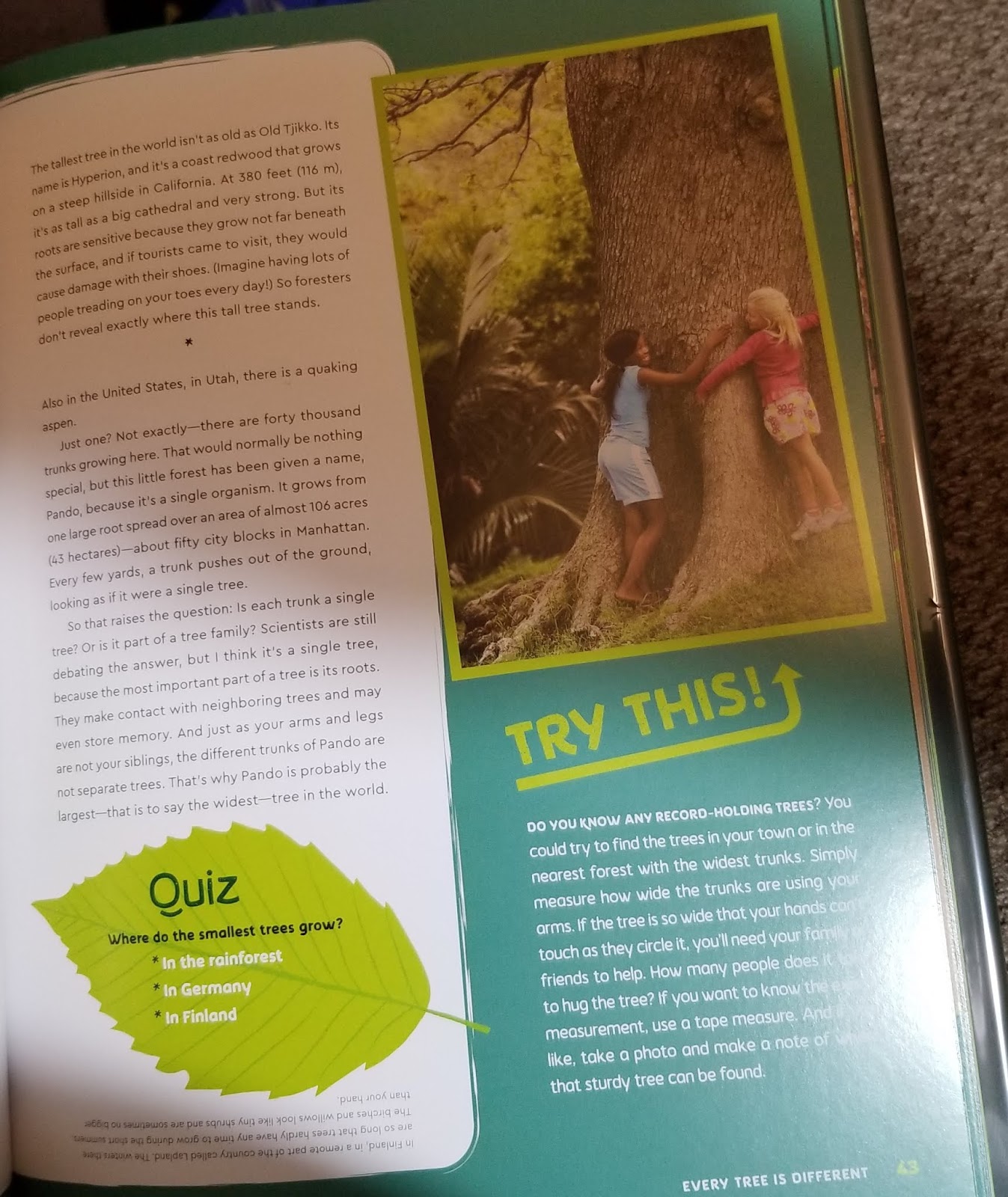
(Wohlleben, 2019, p. 43)
I really enjoy the simple chapters Wohlleben uses to organize the contents of his book. He provides several Try This! Sections scattered throughout the book that gets readers excited about going out into the forest and doing these simple, yet very eye-opening experiments. There are some of them I’m really excited to try myself (see the Use & Extension Activities section for some of my favorites)! There are also Quiz sections that encourage readers to test their critical thinking skills and extends the knowledge of the text. And lastly, there are several simple photographs that represent the information presented in the text in such a way that draws the eye and helps the readers see the true beauty of nature. After reading this book I just wanted to go out and be one with a forest.


I was kind of upset that Wohlleben doesn’t have a section dedicated to helping students learn more, or cite any of his sources. There is a lot of information here that seems really far-fetched, but a citation to the original findings, or other books that also share the same information, would make his claims seem more scientifically founded. I’m also disappointed because I feel like his adult book has better use of sources. Perhaps part of the problem is that there aren’t equivalent sources that he thinks children will be able to understand.


His adult edition of this book has been causing quite the stir in the science world because Wohlleben gives the trees a very human feel to evoke stronger emotions in the readers (Kingsland,2018). I really like this aspect of the book. I’ve always felt like animals are far more intelligent that we give them credit for, so why wouldn’t trees be the same? I think it’s an effective way to raise awareness and encourage conservationism. It also makes a great conversation piece about knowing your audience and how to write persuasive essays.


Reasons to Include this Title in Your Library Collection:


This book is filled with really intriguing facts about forests. It’s not written like a textbook, but instead encourages readers to go outside and explore the forest. It asks readers to see the beauty in nature and consider all of the benefits it provides us. It speaks to our hearts by using words that allow us to relate to forest as if it were our own neighborhood. It allows for a bit of magic to seep into the real world, ensnaring curiosity and unleashing readers’ imaginations.

There are so many wonderful activities and quizzes built into the book to encourage critical thinking, scientific thinking, and wonder. As a reader of mostly fantasy and science fiction, this nonfiction title is like a dream come true.


Read Alikes:


Cover from Goodreads.com

Title: Forest Talk: How Trees Communicate

Author: Melissa Koch

Reason: This book also talks about how trees communicate and their ecological importance to humans and the world at large.


Cover from Goodreads.com

Title: Are Trees Alive?

Author: Debbie Miller

Reason: This book also looks at the everyday life of trees and explores the comparison between trees and humans.


Use & Extension Activities:


  •         Discussion about the importance of citing your sources
  •         Any of the “Try This!” activities. Some of my favorites include:
    • Blowing bubbles using dish soap and a birch log (2019, p. 11)
    •  Find the Fungal Internet! (2019, p. 29)
    • Try out the woodpecker alarm system (2019, p. 47)
    • Build Your Own Water Filter (2019, p. 50) 
  • Take a walk in the forest 
  •            Read some of the scientific critical reviews with older students and have a discussion about whether or not they like the author’s decision to make the trees feel more human. Ask them why they think the author does this. Where have they seen this tactic used before? Does it serve the author’s purpose?
  •         Encourage students to write a story about a tree’s life, from seed to compost. Have them incorporate at least 5 different facts from the book into their make-believe story.


External References:


Kingsland, S. E. 2018. Facts or Fairy Tales? Peter Wohlleben and the Hidden Life of Trees. Bull Ecol Soc Am 99(4):e01443. https://doi.org/10.1002/bes2.1443

Saturday, October 12, 2019

Nonfiction Spotlight: Steal Like an Artist: 10 Things Nobody Told You About Being Creative by Austin Kleon


Title: Steal Like an Artist: 10 Things Nobody Told You About Being Creative

Author & Illustrator:  Austin Kleon

Publisher: Workman Publishing

Copyright date: 2012

Target Audience: Adult with Middle Grade and Young Adult appeal

Lexile Reading Level: N/A

Major Awards Received: Amazon.com Top Best-Selling Book of 2012, Brain Pickings Best Art Books of 2012 , 2012 Goodreads Choice Awards Nonfiction

Book Trailer:


Summary:


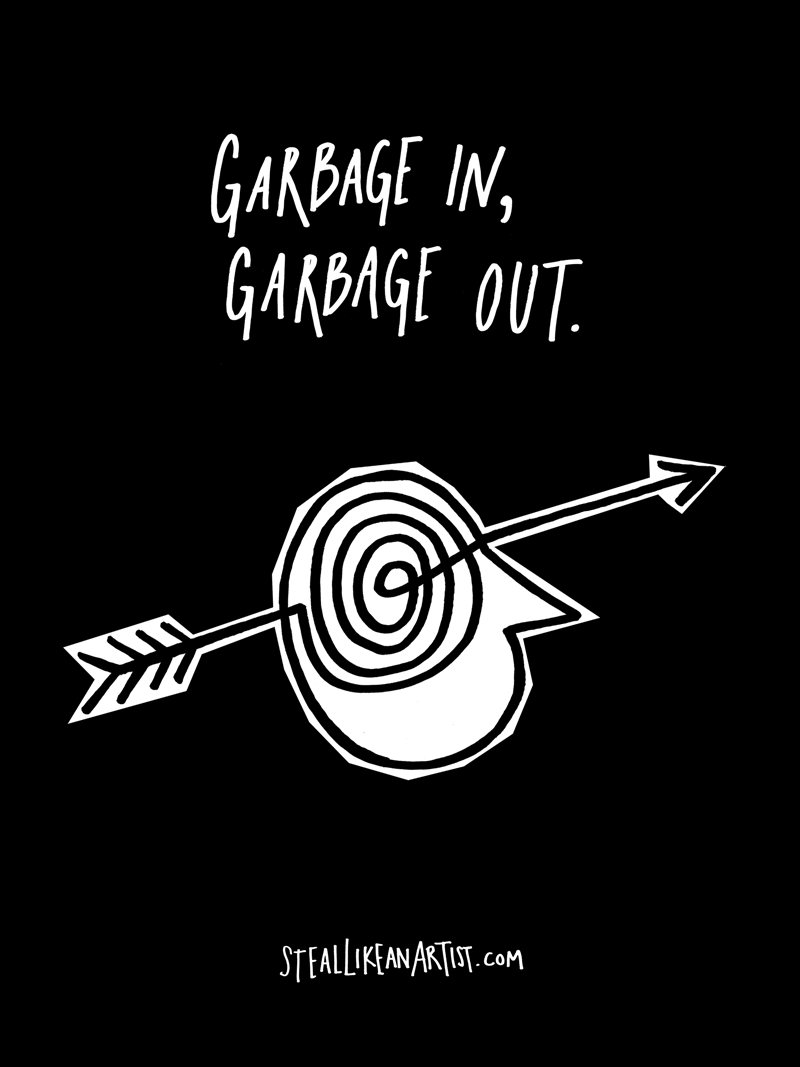
This is a motivational read with strong, positive messages for anyone looking to find themselves, to become an outstanding artist, to love the work they do, and it also reminds readers to take care themselves, emotionally and mentally. Kleon starts off his active title by stating that “all advice is autobiographical” (Kleon, 2012, p. 1) and that his 19-year-old self could use some advice. He had ten tips he gives readers (see image to the right).

Kleon shows us that “stealing like an artist” means letting yourself become inspired by several different artists, weaving the things you like about their work into your own so that you can create your own unique voice and purpose. “Draw the art you want to see, start the business you want to run, play the music you want to hear, write the books you want to read, build the products you want to use—do the work you want to see done” (Kleon, 2012, p. 48). He also has a lot of other really great advice that can apply to any young reader such as, “stay out of debt” (p.121) and “marry well” (p. 133).

Other features of the book include a Table of Contents, What Now? (p. 143), Recommended Reading (p. 145), Y.M.M.V (Your Mileage May Vary) (p.147), Deleted Scenes (p. 148), and a Thank You section (p. 150).

Critique of Contents & Organization:


I love this book. I think I might be a bit biased as an aspiring author, but I really think that there is a lot of good motivational advice here that young readers can relate to, such as “you are, in fact, a mashup of what you choose to let into your life. You are the sum of your influences” (Kleon, 2012, p. 11) and “you’re only going to be as good as the stuff you surround yourself with… your job is to collect good ideas. The more good ideas you collect, the more you can choose from to be influenced by” (p. 13-14).


In chapter 2, Kleon states, “if I’d waited to know who I was or what I was about before I started being creative, well, I’d still be sitting around trying to figure myself out instead of making things. In my experience, it’s in the act of making things and doing our work that we figure out who we are” (2012, p. 27). This is a huge message to readers of any age and any potential career field. Don’t wait to live your life or do the things you want to do. Just do it. Live life before it’s over.

This book makes for a quick read with short text sections, lots of hand drawn graphics, quotes from famous people about their successes at being creative, and hand lettered chapter titles. It reminds me a lot of a blog format. The extra sections of the book (mentioned in the summary help add to Kleon’s message about how to take care of yourself and move forward with the positive life readers are seeking for themselves. For example, the What Now? Section has several mental health suggestions (like “go for a walk”, “take a nap”, and “get yourself a calendar” (Kleon, 2012, p.143)) along with creative suggestions. My personal favorite, however, is “go to the library” (p.143).

Some readers may find the social media or blog lay out of the book to be less traditional then they’re used to—and that’s okay. I think it’s this layout that will help reach the teen and middle grade readers the most. It’s a motivational self-help book geared toward a digitally driven audience of future artists.


Reasons to Include this Title in Your Library Collection:


This is a great motivational read. With all the infographics, pulled out quotes and short chapters, it provides important, inspirational information in a format that even reluctant readers will enjoy. While it will appeal most directly to readers who are interested in creative endeavors, I think it has a lot of general advice as well that can extend beyond just those looking to become famous artists. Lastly, there are lots of use and extension activities.

Use & Extension Activities:

 To be honest, I feel like the What Now? (Kleon, 2012, p. 143) section of Steal Like an Artist makes this section super easy. Great school assignments include:

  •       Start a Swipe File: have students create a collection of ideas from other people that they find interesting or inspiring to use in future work (p.22). Take it one step further and have them “reanimate” (p. 22) one of the works they’ve swiped by using what they’ve found to create their own work.
  •          Buy a Notebook and Use It: have students record things from their daily lives that they find interesting and inspiring. This includes conversations, people watching notes, song lyrics and anything else that might inspire them later (p.21).
  •         Start Your Logbook: have students create a journal of everything they’ve accomplished in a day (p.129).
  •           Write a Fan Letter (p. 108): have students pick their favorite artist (dead or alive) and have them write a fan letter describing which work they liked best. If your student doesn’t know who to write to, Austin would love to hear from them at www.austinkleon.com
  •           Discuss plagiarism (p.33)


Read Alikes: (found through Novelist Plus)


Title: Career Ideas for Kids Who Like Art
Author: Diane Lindsey Reeves
Reason: This book is designed to help young readers find out what kind of career paths they can follow based on what it is they love most about art. Goodreads calls it “highly motivational” and “filled with delightful text and playful illustrations”.  I would suggest this to younger readers over teens.


Title: So, You Want to be a Writer?: How to Write, Get Published, and maybe Even Make it Big!
Author: Vicki Hambleton and Cathleen Greenwood
Reason: This is also a career advice book written in a conversational tone, centered around becoming an author. This book is specifically geared toward teens.


Title: The Arts
Author: A. M. Buckley
Reason: This book also gives advice to young readers about what it takes to become an artist.


--------------------------------------------------------------------------------------------------------------------------
*All images, unless otherwise noted, were downloaded from Austin Kleon’s personal book page steallikeanartist.com and used in accordance with his terms for blog use.


Saturday, September 21, 2019

Nonfiction Spotlight: The Fairy Ring: Or Elsie and Frances Fool the World (A True Story) by Mary Losure


Cover from Goodreads

Title: The Fairy Ring: Or Elsie and Frances Fool the World (A True Story)

Author: Mary Losure

Publisher: Candlewick Press

Copyright date: 2012

Target Audience: Middle Grade

Lexile Reading Level: 940L

Awards Received: Booklist Editors’ Choice, Best Children’s Non-fiction 2012, Horn Book Fanfare 2012, Betsy Bird’s 100 Magnificent Children’s Books of 2012, Society of Midland Authors Award 2013, Best Children’s Non-Fiction, A Junior Library Guild selection


Summary:

When Frances was nine, her father went to fight in the First World War and she and her mother went to stay with her Uncle Arthur, Aunt Polly, and cousin Elsie in the house in Cottingley, Yorkshire, England. It was in the beck behind the Cottingley home that Frances first spotted the little green men all dressed in green she called fairies. When the adults in her life began to tease Frances about the fairy sightings, Elsie stepped in with a brilliant plan. The girls would photograph the fairies and prove the adults wrong! Never has a hoax worked so brilliantly. The Fairy Ring tells the story of Frances moving to Cottingley, meeting the fairies, and altering photographs with cardboard cutouts painted by Elsie that were clever enough to even fool Sir Arthur Conan Doyle, the author of Sherlock Holmes!


"Frances with the Fairies" (Losure, 2012, p.37)

“An intriguing glimpse into a photo-doctoring scandal well before the advent of Photoshop.” - Publishers Weekly  


Critique of Contents & Organization:


This enchanting narrative nonfiction is told in limited third person. The events of the magical and mysterious Cottingley Fairy photographs unfold in chronological order, weaving aspects of the story directly from primary sources such as Frances’s own autobiography and the letters between Elsie’s mother and Mr. Gardner, the man who made Elsie and Frances famous. The whole narration has a very fairy tale-esque feel to it:

“One day when the air was very still, Frances was sitting in her willow tree when she noticed a leaf moving, all by itself. There was no breeze, yet the leaf seemed to be twirling anyway.  It was odd, but Frances didn’t give it much thought until another afternoon, when the same thing happened: one leaf began to twirl. All by itself. As she peered through the willow branches, Frances noticed a little man,” (Losure, 2012, p.19). 


There’s even a section about the end of the First World War, when Frances’s uncle refuses to let anyone go into town and enjoy the festivities (Losure, 2012, p.46), much in the same vein as an evil stepmother might.


The story is broken up into three parts (Frances’s Fairies, Elsie, Frances and Elsie) with several short chapters within each part. Each chapter is listed on the Table of Contents page.  There’s an Acknowledgements (p. 167) section, Source Notes (p. 169), Image Credits (p. 178), Bibliography (p. 179), and an Index (p. 181).


The writing style, organization and content really works well for this story. I loved the fact that there were so many photographs included through out the story. I only wish they had been in color like the ones you can find online—with that said, I also really appreciate that they’re photographs of the original photographs, which did not have color at the time.


Reasons to Include this Title in Your Library Collection:

In her Acknowledgments page Mary Losure states that “for a long time, I’ve been interested in true stories with children as their heroes” (p. 167).  I think its very important to encourage children to imagine themselves as the heroes and to explore the wonders and mysteries of this world that may or may not be real.


This book does a wonderful job of setting readers up for critical thinking. Much like an article from Sir Arthur Conan Doyle, Losure sets the facts before us but leaves the final verdict up to us, inspiring critical thinking in those who partake in her story. “It was true that Frances had lied about the first four photographs. But that didn’t mean the last one was a fake” (p.163) and “But surely, now, the audience can tell that what’s inside it is not a joke or a hoax. It’s a fairy story with big, strong, wings that can fly people’s imaginations to gorgeous and fairyland places” (p. 166).

Use & Extension Activities:

  •           Have children take their own nature pictures—do they see anything that could resemble a fairy creature?
  •           Have children research if there have been other fairy sightings outside of the ones mentioned in the book
  •           Have older readers write a persuasive essay about whether fairies are real or imaginary using information they found in the book and outside sources.
  •           Have children research modern day hoax pictures and discuss the idea of “Fake News”. 

Read Alikes:

Provided by Novelist Plus:


Author: Gail Jarrow

Audience: Middle Grade

Reasoning: This narrative nonfiction covers the radio reading of "War of the Worlds", an unintentional hoax in 1938 that had America panicking about a fictional Martian invasion. 


Author: Marc Aronson

Audience: YA

Reasoning: This narrative nonfiction looks at the events surrounding the Salem Witch Trials. It is told in the same mysterious unfolding of events that allows readers to determine what was truth, half-truth, and outright lies.


Monday, September 2, 2019

Nonfiction Spotlight: Separate is Never Equal by Duncan Tonatiuh


Title: Separate is Never Equal: Sylvia Mendez & Her Family’s Fight for Desegregation

Author & Illustrator:  Duncan Tonatiuh

Publisher: Abramas Books for Young Readers

Copyright date: 2014

Target Audience: Elementary Students

Lexile Reading Level: AD870L

Major Awards Received: Robert F. Sibert Informational Book Medal


Summary:

This illustrated narrative is about the family behind the Mendez v. Westminster School District court case in 1947 and their fight to desegregate their public school system. Sylvia and her siblings were told that they could not attend the normal public school in Westminster, California, but instead had to go to the “Mexican School”. Sylvia, her siblings, and their mother were native born American citizens, and while her father was from Mexico, he had been naturalized well before their move to Westminster. This did not matter to the school superintendent, the county superintendent, nor the school board. Sylvia’s father fought for his children to have the right to attend the public school, which received better funding, and had better teachers that actually cared about the students it served. He filed a lawsuit and won, not once, but twice.
Separate is Never Equal page 6


The book starts in medias res, starting with Sylvia’s first day of school after her family has fought for and won the right to attend the public school with the rest of the children in town. When Sylvia comes home and tells her parents that she doesn’t want to return because the other children are mean to her, they gently remind her of why she is where she is, and the importance of her being there, for herself and for any other child facing prejudice.  The book closes with Sylvia returning to school, ignoring the bullies, and learning to make friends with children of many different backgrounds.


The book contains distinct illustrations created by the author, Duncan Tonatiuh. According to his webpage, his artwork is inspired by the Mixtec codex, a type of Pre-Columbian art. Some of the more distinguishing features of his artwork include characters’ ear shape, the very simple, yet textured background images, and the use of only profile images for the characters in the story. An example is shown to the right.


Other features of the book include an Author’s Note (p. 36), a Glossary (p. 38), a Bibliography (p.39), a note About the Text (p. 39), and an Index (p. 39).


Critique of Contents & Organization:


The content and organization of this book is spot on for the information presented and the target audience. I really appreciate that Tonatiuh provides actual dialogue from the Mendez v. Westminster School District court case. This not only adds to the book’s accuracy, but it also provides a very eye-opening example of how people really think and feel about someone who is different from them. The ability we have as readers to see Sylvia’s thoughts during the trial in response to the questions is also powerful, as it teaches children that there are two sides to every story and the importance of asking questions instead of making assumptions when they meet someone new and different than themselves.


“Segregation tends to give an aura of inferiority. In order to have the people of the United States understand one another it is necessary for them to live together, and the public school is the one mechanism where all the children of all the people go” (Tonatiuh, 2014, p. 29).

The additional features at the end of the book also provide a lot of information that furthers readers’ knowledge on the topic. I appreciate the inclusion of a glossary and index. This way Tonatiuh is able increase readers’ vocabulary and tell the story without choosing less precise words.

The use of the illustrations are also very appropriate and powerful. For instance, the images depicting the two different schools very easily tells a young reader all they need to know about which school they would rather attend. (See the two illustrations below).


Reasons to Include this Title in Your Library Collection:


In his Author’s Note, Tonatiuh, makes a statement that includes many really important reasons why his book should be included in a library collection for youth:


“My hope is that this book will help children and young people learn about this important yet little known event in the American history. I also hope that they will see themselves reflected in Sylvia’s story and realize that their voices are valuable and that they too can make meaningful contributions to this country” (Tonatiuh, 2014, p.36). 


Before reading this book, I was not aware that there were court cases on segregation before Brown v. Board of Education. I haven’t come across a whole lot of books on this topic for this particular age group either—making it even more important to purchase for a public library collection!

I love that Tonatiuh wants to encourage children to make meaningful contributions to their country. This is a very important facet of being a United States citizen, one that gets overlooked far too often. With Segregation is Never Equal, teachers and parents can open a discussion about civic duty with their children and the importance of taking care of our country and the people that live here.


Lastly, Tonatiuh states that:

“the Mendez family went to court almost seventy years ago, but their fight is relevant today” (2014, p. 36). 

 As this is a pertinent topic that resonates with several of my community members and branches out as an important topic nation wide with our government’s current stance on immigration, this book deserves a space on my library shelf.  


Use & Extension Activities:


  •           Discussions about segregation
  •           Discussions about immigration
  • Discussions about race and nationality
  • Discussions about ways students/children can better their county

Pete the Kracken and the Angry Storm Cloud

  Hello, Readers! Happy Black Friday if you're partaking in the chaos that is "the biggest gift shopping day of the year". I h...

Popular Posts