Wednesday, November 27, 2019

Nonfiction Spotlight: Anne Frank's Diary


Title: Anne Frank’s Diary: The Graphic Adaptation


Adapted By: Ari Folman


Illustrated By: David Polonsky


Publisher: Anne Frank Fonds


Copyright date: 2018


Target Audience: Teens


Lexile Reading Level: GN800L


Book Trailer:


Anne Frank's Diary, page 5. This illustration captures
the feel of Anne's Diary--it's like Anne is
whispering all of her secrets to her best friend.

Summary:

This is an Anne Frank graphic novel biography, adapted from her original diary by Ari Folman and David Polonsky on behalf of the Anne Frank Fonds. While they admittedly could not transfer every diary entry and word into a graphic format, they did take five years to determine which scenes were best represented in graphics and tried their best to “remain true to Anne Frank’s memory and legacy” (p. 149). This adaptation starts on June 12, 1942-the day Anne received her dear diary, Kitty for her 13th birthday, to August 1st, 1944-three days before Anne’s family is arrested and sent away to concentration camps. It details Anne’s day-to-day life and struggles as she hides from the Nazis in the secret apartment of her father’s jam stabilizing company.

Anne Frank's Diary page 42, The date is written
across the  top of the page like a typical diary entry 
and is accompanied by Polonsky's vivid animations.


Critique of Contents & Organization:

This book has a Cast of Characters, Afterword (p.146), Adapter’s Note (p. 148), A Note About the Author (p.151), A note About the Adapter (p.151), and A Note About the Illustrator (p.151).
The organization of the novel is much like an illustrated diary. The date is listed across the top of the page and Ari Folman expertly weaves Anne’s original diary text into the frames, sometimes as nothing more than a diary entry, sometimes accompanied by David Polonsky’s startlingly vivid animations. 
I love how they hold their comic-like art quality, but some how feel very realistic. Perhaps it’s because the familiar words and horrific situations are presented visually and cannot be ignored or as easily filtered by the mind.

Anne Frank's  Diary, page 28. I love
how we get to see Anne's personality 
come to light in Polonsky's illustrations.


I love all the instances where readers get to see Anne’s personality come to light in the illustrations. Polonsky does a great job of expressing her emotions. I also really loved seeing the drawings that mapped out the Annex. As someone who has never visited the Anne Frank Museum, it was very interesting to finally give the space a visual representation.
Anne Frank's Diary, page 35. This is the rendition of the Annex
where Anne, her family and the Van Daan's hid from 1942-1944.

I feel that together, Folman and Polonsky have made Anne very relatable in their adaptation and have created a powerful and important gateway into a tragic and horrific time in history for reluctant teenage readers.


Reasons to Include this Title in Your Library Collection:

This adaptation is perfect for reluctant teenage readers and any fans of graphic novels or comics—but still portrays an accurate account of an important and tragic time in history. I feel like the graphic novel version has an advantage over the written text in that it doesn’t allow readers to skim over the details that are too horrific or difficult for the mind to handle. For example, to the right is an example of Anne’s constant nightmares. We can read about them in her diary, but there are no visuals for us to connect with so they might not have as big of an impact on readers. However, in the graphic novel adaptation it’s hard not to be haunted by the visual representations of her nightmares.

Use & Extension Activities:

  •     Discussion of WWII and the Holocaust
  •     Compare and Contrast the original Diary to the Graphic Novel Adaptation
  •     Have a Holocaust Survivor visit your school or library (Scholastic)
  •     Investigate past and present instances of government sanctioned intolerance and genocide (Scholastic)

Read Alikes:
Author:  Anne Frank
Reason: This is Anne Frank’s original diary, if readers want to know more about Anne Frank, this is the book to read.


Author:  Art Spiegelman
Reasoning: This is another graphic novel of a Holocaust Survivor’s Tale and how the Holocaust affected his family even after the war was over. While it doesn’t shy away from any of the graphic details, it has been marked on Goodreads and Common Sense Media as a must read for teenagers and adults interested in learning more about the Holocaust. 

Sunday, November 3, 2019

Nonfiction Spotlight: Kids Bake!


This post was inspired by a friend’s blog post, Literal Candy Crushes by NeriSiren. For Halloween she posted some of her favorite treats found throughout the different books she’s been reading. Everything sounded so good I proposed a bake off and suddenly found myself in need of a good cookbook for beginners!
Cover from Goodreads

Title: Good Housekeeping Kids Bake! 100+ Sweet and Savory Recipes

Author: Good Housekeeping

Publisher: Hearst Books

Copyright date: 2018

Target Audience: Elementary & Middle Grade

Lexile Reading Level: N/A


Summary:


This active cookbook is for aspiring young chefs. It takes the time to explain basic baking terms, measurements and utensils in an easy to understand manner. It has several stunning photos and includes over 100 mouth watering recipes ranging from cookies to tasty pizzas. Just looking at the pictures alone made me super hungry. Susan Westmoreland, the editor for the book states in her Forward, “once you try our Granola Bars or Glazed Cinnamon Rolls, you won’t want to buy them again!” (Good Housekeeping, 2018, p. 7). Personally, I can’t wait to try a few of these recipes out myself!


Critique of Contents & Organization:


This table from page 15 extends the readers 
knowledge of common measurement equivalents.

In the Introduction, the editor explains how to use the book, what equipment and tools bakers will need, the basic ingredients to always keep on hand, how to measure with accuracy, the importance of healthy nutrition, which pans to use when, what different baking terms mean, and basic kitchen safety. This information is presented in a very straightforward manner that doesn’t make a reader feel stupid for not knowing the terms or proper uses for the different types of spatulas (in case you’re curious, “Rubber spatulas are used to fold in flour mixtures as well as to scrape bowls. A wide metal spatula is used to remove cookies and pizzas from hot cookie sheets. A narrow metal spatula or mini offset spatula is the go-to tool for frosting cakes and cupcakes and spreading glazing” (p. 11).


The images, photographs and tables are used to represent directions in the recipes, final, mouth watering treats, and further extend readers’ knowledge by providing information not presented in the text. For example, here are some tasty treat photos, and a table used to convey common baking measurements.


I really appreciate the way the recipes are organized. It lists the Active Time, Total Time, and servings under the recipe title so that bakers can make sure they have enough time to make the treats without feeling rushed. The ingredients are listed down the left-hand side, and below that is the nutritional information. The largest section is geared toward the baking directions. Some pages even have extra photos that explain what some of the less common ingredients are. For example, in this recipe, there’s an information box about what rhubarb is. Most of the recipes also have mouth watering photos of what the final treats look like.
Example of how recipes are set up throughout the book.


Reasons to Include this Title in Your Library Collection:


This book does a wonderful job of introducing aspiring chefs to the basics of baking in a fun and engaging way. Active nonfiction titles such as this give readers knowledge they can apply immediately, teaching them that reading has a real-world application. Because it also explains the basics of nutrition, it also teaches healthy eating in a nonpreachy manner.

Use & Extension Activities:


  •           Make a recipe together in class
  •           Have students make a treat at home to share with the class
  •           If you aren’t a teacher, but a parent, have your child pick out a recipe they’re interested in and make it together
  •           Have a bake sale to raise funds for a local charity


Read Alikes:

Title: Good Housekeeping Kids Cook!

Author: Good Housekeeping

Reason: This cookbook was put together by the same editor as Kids Bake! And has the same set up, great pictures and nutritional information.

Title: The Complete Baking Book for Young Chefs

Author: America’s Test Kitchen

Reasoning: This is another book with baking recipes for aspiring young chefs. This book is also filed with several amazing photos and great recipes.


Title: Cooking Class: 57 Recipes Kids Will Love to Make (and Eat!)

Author: Deanna F. Cook

Reasoning: This book includes cooking and baking recipes for first time chefs. It also has awesome pictures and step-by-step instructions that makes learning to cook fun and interesting.


Monday, October 28, 2019

Nonfiction Spotlight: Can you Hear the Trees Talking?


Cover from Goodreads.com

Title: Can You Hear the Trees Talking? Discovering the Hidden Life of the Forest

Author:  Peter Wohlleben

Publisher: Greystone Kids

Copyright date: 2019

Target Audience: Middle Grade

Lexile Reading Level: 900L


Summary:


Cover from Goodreads.com
Can You Hear the Trees Talking is the young readers’ adaptation of Peter Wohlleben’s New York Times Bestseller title, The Hidden Life of Trees. It’s filled with mind blowing revelations about how trees live as a community in forest settings. Did you know that trees have their own internet service? Or that they sleep at night? How about the fact that trees get pimples? The most important secret Wohlleben shares with young readers, however, is the fact that forests are important and deserve to be saved.of the forest is that it is important and deserves to be protected.


Other features of the book include Table of Contents, Let’s Go on a Journey of Discovery (p. 2-3), which is an author’s note to the young readers about what they will learn in this book, who the author is, and the importance of learning about forest life and the hidden world of trees, Photo Credits (p. 74-75), and an Index (p. 76-78), which gives readers directions on how to use it!

Critique of Contents & Organization:


There are some awesome pictures and facts in this book. Some of the facts are more common than others. For example,
(Wohlleben, 2019, p. 4-5)

 “Of course, there are no bathtubs in the forest, which means that beech trees have to get every drop of water from the ground. They do this using their roots to feel for the spots where it’s nice and moist” (2019, p. 8).

Most middle grade readers will know that trees use their roots to suck water up from the ground. However, even as a person who focused her undergraduate thesis on forest research, I did not know that a

“tree will taste who is nibbling on it. Yes, you read that right: trees can taste. Because whenever an animal bites into the bark, a leaf, or a branch, it injects a bit of saliva into the wound. And every animal’s spit tastes different” (2019, p. 26). 


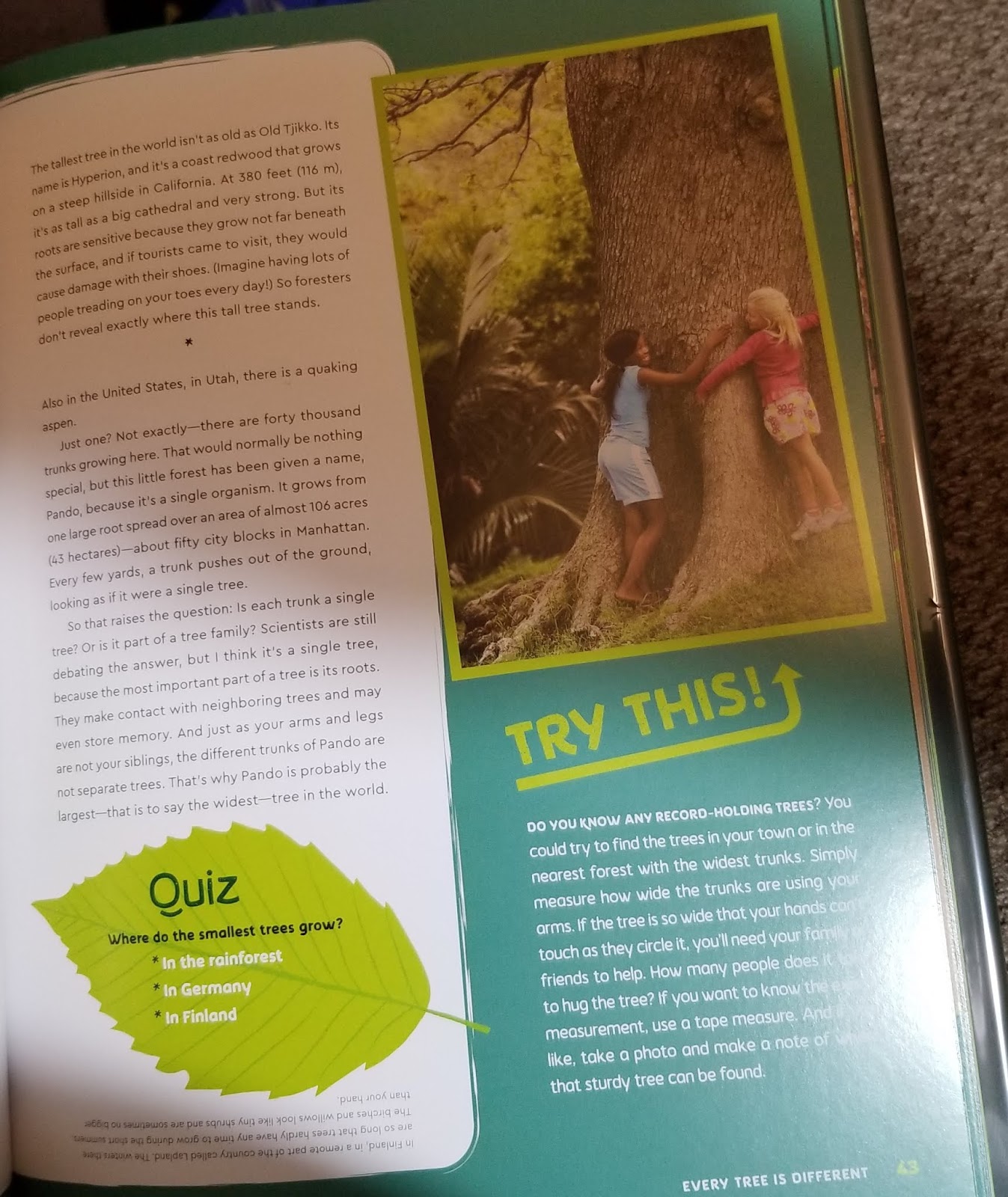
(Wohlleben, 2019, p. 43)
I really enjoy the simple chapters Wohlleben uses to organize the contents of his book. He provides several Try This! Sections scattered throughout the book that gets readers excited about going out into the forest and doing these simple, yet very eye-opening experiments. There are some of them I’m really excited to try myself (see the Use & Extension Activities section for some of my favorites)! There are also Quiz sections that encourage readers to test their critical thinking skills and extends the knowledge of the text. And lastly, there are several simple photographs that represent the information presented in the text in such a way that draws the eye and helps the readers see the true beauty of nature. After reading this book I just wanted to go out and be one with a forest.


I was kind of upset that Wohlleben doesn’t have a section dedicated to helping students learn more, or cite any of his sources. There is a lot of information here that seems really far-fetched, but a citation to the original findings, or other books that also share the same information, would make his claims seem more scientifically founded. I’m also disappointed because I feel like his adult book has better use of sources. Perhaps part of the problem is that there aren’t equivalent sources that he thinks children will be able to understand.


His adult edition of this book has been causing quite the stir in the science world because Wohlleben gives the trees a very human feel to evoke stronger emotions in the readers (Kingsland,2018). I really like this aspect of the book. I’ve always felt like animals are far more intelligent that we give them credit for, so why wouldn’t trees be the same? I think it’s an effective way to raise awareness and encourage conservationism. It also makes a great conversation piece about knowing your audience and how to write persuasive essays.


Reasons to Include this Title in Your Library Collection:


This book is filled with really intriguing facts about forests. It’s not written like a textbook, but instead encourages readers to go outside and explore the forest. It asks readers to see the beauty in nature and consider all of the benefits it provides us. It speaks to our hearts by using words that allow us to relate to forest as if it were our own neighborhood. It allows for a bit of magic to seep into the real world, ensnaring curiosity and unleashing readers’ imaginations.

There are so many wonderful activities and quizzes built into the book to encourage critical thinking, scientific thinking, and wonder. As a reader of mostly fantasy and science fiction, this nonfiction title is like a dream come true.


Read Alikes:


Cover from Goodreads.com

Title: Forest Talk: How Trees Communicate

Author: Melissa Koch

Reason: This book also talks about how trees communicate and their ecological importance to humans and the world at large.


Cover from Goodreads.com

Title: Are Trees Alive?

Author: Debbie Miller

Reason: This book also looks at the everyday life of trees and explores the comparison between trees and humans.


Use & Extension Activities:


  •         Discussion about the importance of citing your sources
  •         Any of the “Try This!” activities. Some of my favorites include:
    • Blowing bubbles using dish soap and a birch log (2019, p. 11)
    •  Find the Fungal Internet! (2019, p. 29)
    • Try out the woodpecker alarm system (2019, p. 47)
    • Build Your Own Water Filter (2019, p. 50) 
  • Take a walk in the forest 
  •            Read some of the scientific critical reviews with older students and have a discussion about whether or not they like the author’s decision to make the trees feel more human. Ask them why they think the author does this. Where have they seen this tactic used before? Does it serve the author’s purpose?
  •         Encourage students to write a story about a tree’s life, from seed to compost. Have them incorporate at least 5 different facts from the book into their make-believe story.


External References:


Kingsland, S. E. 2018. Facts or Fairy Tales? Peter Wohlleben and the Hidden Life of Trees. Bull Ecol Soc Am 99(4):e01443. https://doi.org/10.1002/bes2.1443

Pete the Kracken and the Angry Storm Cloud

  Hello, Readers! Happy Black Friday if you're partaking in the chaos that is "the biggest gift shopping day of the year". I h...

Popular Posts